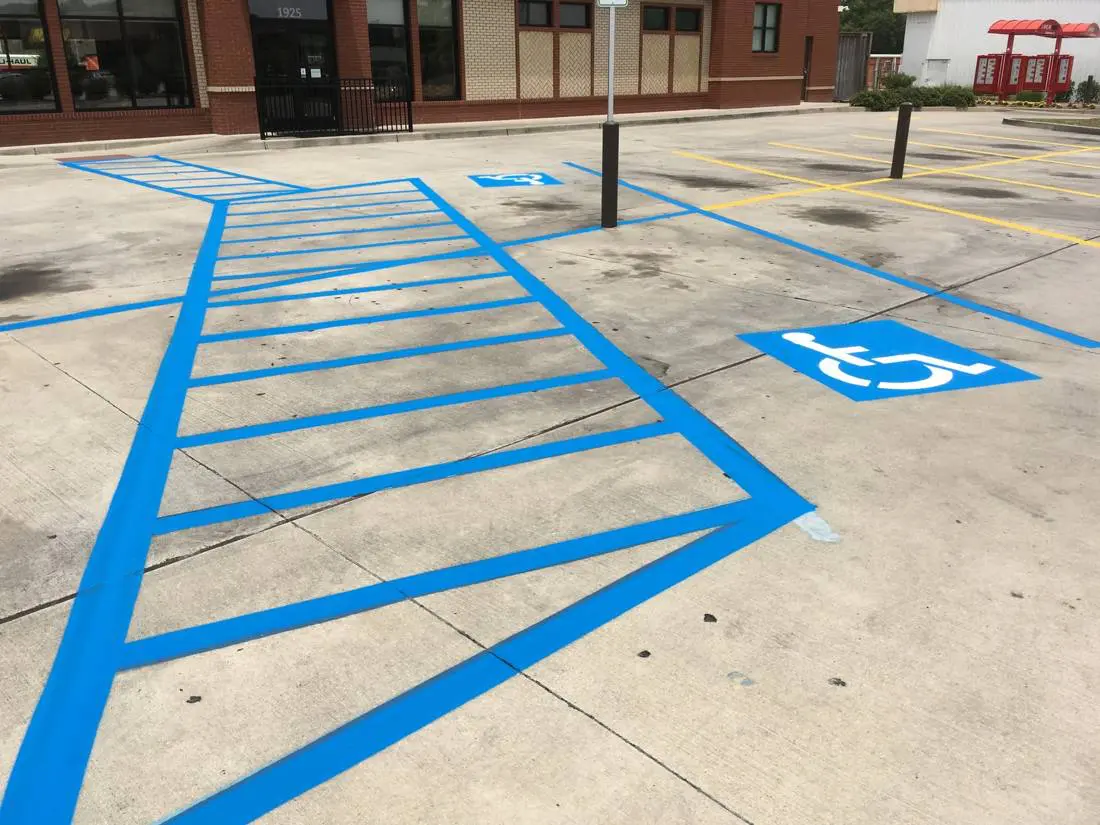
Louisiana ADA Parking Requirements: The Access-Aisle NO PARKING Rule
Louisiana access aisle requirements for commercial parking lots
Louisiana requires the words NO PARKING, in letters at least 12 inches tall, on every access aisle beside an accessible parking space. The rule, R.S. 40:1742(A)(4), covers new spaces and any existing spaces whose markings are repainted after August 1, 2013. Federal ADA rules still set the aisle’s 60-inch minimum width, the number of spaces and the signs.
TLDR:
- The lettering rule: NO PARKING, 12-inch minimum letters, painted in the aisle.
- It applies to new spaces and to existing spaces repainted after August 1, 2013.
- The ADA sets the widths: 96-inch car spaces, 132-inch van spaces, 60-inch aisles.
- The number of accessible spaces comes from one table, and 1 in 6 must be van accessible.
- A restripe is when the rule usually comes due, so plan the lettering into the layout.
- Since July 1, 2026, Louisiana checks accessibility against IBC Chapter 11. The counts did not change.
If you manage a retail center, an office park, a clinic or a church lot between Hammond, Baton Rouge and the Northshore, this rule tends to surface at the worst moment. The lot gets restriped, a tenant or visitor complains, and someone asks why the aisle does not say NO PARKING. The answer is usually that nobody put the lettering in the layout.
This guide covers what the statute says, how it fits with the federal ADA and Louisiana’s building code, and what to plan before your next restripe. It is general information, not legal advice.
Restriping soon? Send the address and a few photos. RPM will plan the accessible stalls, aisles and lettering into the layout with you.
What does R.S. 40:1742 actually say?
The rule is one paragraph of Louisiana law, and it is more specific than most people expect. Here is the operative sentence, quoted from the Louisiana Legislature’s current text.
“In addition to the ADA Standards specifications, each access aisle, or any other area of the pavement adjacent to a parking space reserved for persons with mobility impairments that is designated for the loading and unloading of vehicles parked in the space, shall have the phrase “NO PARKING” written upon the pavement area using letters that are not less than twelve inches tall.”
Three details matter for a property manager. First, the words are fixed: NO PARKING. Second, 12 inches is a minimum letter height, so larger lettering is fine. Third, the rule covers “any other area of the pavement” used for loading and unloading, not only an aisle drawn with hatch lines.
The same paragraph sets the trigger. It applies to “all parking spaces newly constructed or existing parking spaces whose markings are repainted after August 1, 2013.” That date comes from Act 164 of the 2013 Regular Session, which added the lettering requirement to the statute.
The rule also reaches further than public buildings. It covers private property “open to the public and to which the public is invited for commercial or governmental purposes,” which describes most shopping centers, offices, restaurants and medical buildings. The next question is how this Louisiana rule sits alongside the federal one.
How do the federal ADA rules and Louisiana’s rules fit together?
Think of one lot with three layers of rules on it. They do not conflict, and each one answers a different question.
The federal layer is the 2010 ADA Standards for Accessible Design. They set how many accessible spaces a lot needs, how wide the spaces and aisles are, the slope limit and the sign height. On marking, they say only that aisles “shall be marked so as to discourage parking in them,” and the official advisory note adds that the method “may be addressed by State or local laws.”
Louisiana answered that note directly. The NO PARKING lettering is the state’s chosen method, and it applies on top of the federal standard.
The third layer is the building code. Under R.S. 40:1733, Louisiana now points plan review to International Building Code Chapter 11 and the referenced ICC A117.1 standard. For parking counts, that code uses the same numbers as the ADA table, so the practical effect on your lot is small. Now to the measurements a restripe has to hit.
How wide do accessible spaces and access aisles have to be?
The widths are where most layout mistakes happen, because an older lot may have been painted to a different standard. These are the federal minimums from section 502 of the 2010 Standards.
- Car accessible space: 96 inches wide, with an adjacent access aisle.
- Van accessible space: 132 inches wide with a 60-inch aisle, or 96 inches wide with a 96-inch aisle.
- Access aisle: 60 inches wide minimum, running the full length of the space, and two spaces may share one aisle.
- Level surface: the aisle sits at the same level as the space, with slopes no steeper than 1:48.
- Vans: 98 inches of vertical clearance along the space, aisle and route.
- Signs: the International Symbol of Accessibility, “van accessible” on van spaces, mounted with the bottom of the sign at least 60 inches above the ground.
Widths are measured from the centerline of the stripes, which is why a restripe that shifts lines by a few inches can change whether a space measures correctly. The aisle must also adjoin an accessible route, and the U.S. Access Board’s parking guide notes that no bollards, columns or poles may encroach into it.
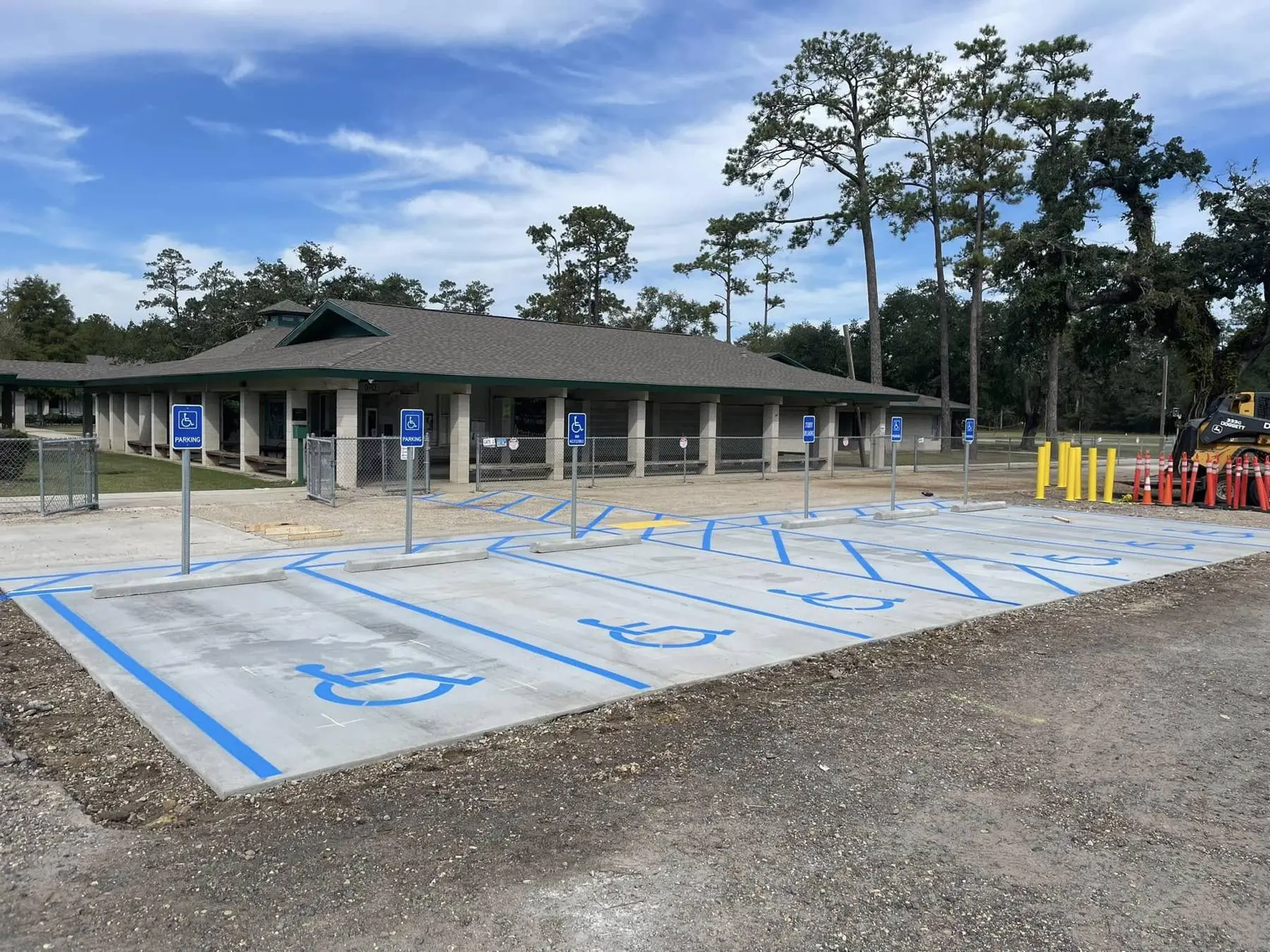
With the dimensions set, the next number a layout needs is how many of these spaces to paint.
How many accessible spaces does a commercial lot need?
The count comes from Table 208.2 of the ADA Standards, and Louisiana’s building code table uses the same numbers. Count each lot or garage on a site separately, not the site as a whole.
| Total spaces in the lot | Minimum accessible spaces | Minimum van-accessible spaces |
|---|---|---|
| 1 to 25 | 1 | 1 |
| 26 to 50 | 2 | 1 |
| 51 to 75 | 3 | 1 |
| 76 to 100 | 4 | 1 |
| 101 to 150 | 5 | 1 |
| 151 to 200 | 6 | 1 |
| 201 to 300 | 7 | 2 |
| 301 to 400 | 8 | 2 |
| 401 to 500 | 9 | 2 |
| 501 to 1,000 | 2 percent of total | 1 of every 6 accessible, rounded up |
| 1,001 and over | 20, plus 1 for each 100 over 1,000 | 1 of every 6 accessible, rounded up |
In practice, a 120-space retail lot needs 5 accessible spaces, and at least 1 of them must be van accessible.
Medical buildings follow different percentages. Hospital outpatient facilities need 10 percent of patient and visitor spaces to be accessible, and rehabilitation or outpatient physical therapy facilities need 20 percent. The Standards’ advisory note says doctors’ offices and independent clinics that are not part of a hospital use the normal table.
Employee lots count too. The Access Board’s guide says the requirements “apply equally to employee parking facilities,” and gravel or grass overflow lots still need marked spaces with firm, stable surfaces.
Not sure your stall count is right? RPM can check the current layout and plan the accessible spaces, aisles and lettering before anything is painted.
Does restriping a lot trigger the NO PARKING rule?
This is the question property managers ask most, and the answer depends on which rule you read. Louisiana’s is the simplest of the three.
The U.S. Department of Justice’s restriping brief, last updated in 2020, says that when a business restripes a lot “it must provide accessible parking spaces as required by the 2010 ADA Standards.” It also notes that restriping is “relatively inexpensive,” so it is usually a readily achievable way to remove barriers. The brief is guidance, not a regulation.
The Access Board draws a finer line. It says “refreshing existing striping in place for several spaces or filling potholes is typically considered normal maintenance,” while resurfacing, resealing or reconfiguring a lot is an alteration that must include the required accessible spaces.
Louisiana’s lettering rule has no maintenance carve-out in its text. It applies to “existing parking spaces whose markings are repainted after August 1, 2013.” The plain reading is that repainting the accessible spaces brings the NO PARKING lettering with it. For edge cases, check with your local building official, who shares enforcement authority under R.S. 40:1740.
The practical takeaway is to plan the lettering into any restripe or seal-and-stripe job from the start, and our guide on how often a commercial lot needs restriping covers when that job usually comes due. The cost of skipping the lettering shows up in the fines.
What are the fines in Louisiana?
Most people know drivers can be ticketed. Fewer know the statute also reaches the owner or lessee who fails to keep accessible spaces usable.
| Who | Violation | Amount | Statute |
|---|---|---|---|
| Driver, first offense | Parking in an accessible space without a plate, hang tag or card | $275 | R.S. 40:1742(B)(3) |
| Driver, later offenses | Same | $500 | R.S. 40:1742(B)(3) |
| Violator that is not an individual | Same | $500 | R.S. 40:1742(B)(4) |
| Local add-on, where adopted | Each accessible parking violation | $25 more | R.S. 40:1742.1 |
| Owner or lessee | Not keeping reserved spaces free of obstructions | Up to $500 | R.S. 40:1742(A)(3) |
| Anyone violating the Part, including the lettering rule | Not complying with a fire marshal order | Up to $500, and each day can count separately | R.S. 40:1743 and 40:1621 |
The last row is the one that applies to the lettering. Under R.S. 40:1743, violations are handled through R.S. 40:1621, which sets the fine for failing to comply with a fire marshal order. Parishes and cities may add their own ordinances and the $25 local fine under R.S. 40:1742.1.
Driver fines under the section cannot be reduced or suspended, and a vehicle that is not moved on request can be towed. Those rules were joined by a code change in 2026.
What changed in 2026, and what did not?
Louisiana changed its state accessibility standard on July 1, 2026, and the headlines made it sound bigger for parking lots than it is.
Act 534 of 2024 made International Building Code Chapter 11, with the referenced ICC A117.1 standard, the state accessibility standard. Louisiana currently uses the 2021 IBC, and the Louisiana State Uniform Construction Code Council lists the 2024 editions as scheduled for January 1, 2027.
What did not change matters more for a lot. R.S. 40:1742 was not amended, so the 12-inch NO PARKING rule still stands. The 2021 IBC’s Table 1106.2 uses the same space counts as the ADA table, and it keeps the 1-in-6 van ratio. The federal ADA Standards still apply on their own.
What Louisiana property managers ask about access aisles
These are the questions that come up when a lot is due for a restripe. Each answer points to the rule it comes from.
How tall do the NO PARKING letters have to be in Louisiana?
At least 12 inches tall. R.S. 40:1742(A)(4)(a) requires the phrase NO PARKING, painted on the pavement in the access aisle or other loading area beside an accessible space, in letters not less than twelve inches tall. Larger letters meet the rule. The statute does not set a color, so match the rest of the accessible layout.
Does the federal ADA require the words NO PARKING?
No. Section 502.3.3 of the 2010 ADA Standards only requires access aisles to be marked so as to discourage parking in them, and its advisory note leaves the method and color to state or local law. Louisiana chose the method, so in this state the NO PARKING lettering applies on top of the federal marking requirement.
How wide does an access aisle have to be?
At least 60 inches wide for car and van spaces, running the full length of the parking space it serves. It must sit at the same level as the space, with slopes no steeper than 1:48. A van space can use a 96-inch space with a 96-inch aisle instead of the 132-inch space with a 60-inch aisle.
Do I have to add the lettering if I only repaint the lines?
Louisiana’s rule applies to existing spaces whose markings are repainted after August 1, 2013, and its text has no exception for touch-ups. The plain reading is yes, if the accessible spaces are repainted. The Access Board treats small in-place touch-ups as maintenance under federal rules, so confirm edge cases with your local building official.
How many van-accessible spaces does a lot need?
At least one of every six accessible spaces must be van accessible, rounded up, so every lot with an accessible space has at least one van space. A lot with 201 to 500 total spaces needs two. Both the 2010 ADA Standards and the 2021 IBC use the same one-in-six ratio.
Can a property owner be fined over accessible parking?
Yes. An owner or lessee who fails to keep reserved accessible spaces free of obstructions can be fined up to $500 under R.S. 40:1742(A)(3). Violations of the part that includes the lettering rule are handled through a fire marshal order, with fines up to $500 and each day of violation counted separately.
Planning the lettering into your next restripe
The simplest way to stay on the right side of R.S. 40:1742 is to treat the accessible stalls as part of the layout, not an afterthought. Before a restripe, confirm the stall count against the table, check the aisle widths and slopes, look at the signs, and plan the NO PARKING lettering in each aisle.
RPM Services is based in Hammond and has been in the trade since 2017. When a lot is restriped, the accessible stalls, symbols, aisles and the NO PARKING lettering Louisiana requires are part of the layout we plan with you on our commercial parking lot restriping work. You can see a finished example in our new accessible parking row project, or read more about RPM Services.
Get the accessible layout right the first time. You get a written quote before any work starts, and the stall count, aisles and lettering are planned with you.